BRIEF SUMMARY OF MY BLOG ENTRY
This blog entry is going to summarize all my blog entries that
I have published so far. Since from the beginning I have been writing about
Limpopo Province, but my focus was about the illustration about the province
itself, town's, the culture, rituals, traditional dances, kingship of Vhavenda
people, the history of Thohoyandou and Vhavenda. My aim was to make known of my
home town to those who do not even know that there is a place called Venda in
Limpopo province.
My first blog entry focused more on introducing the province
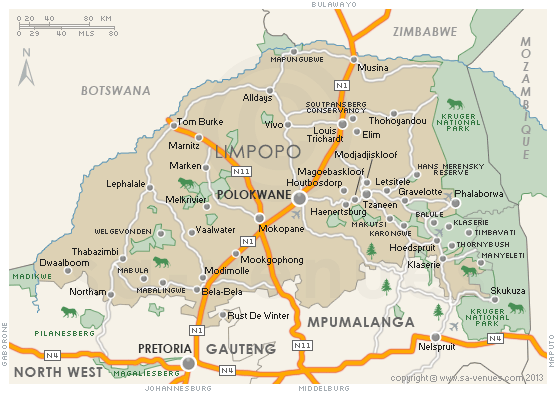
itself and introduced the capital of Limpopo which is Polokwane. In this blog
the map which shows Limpopo as a whole was given and by the results of this map
one can now see and know more about the towns, village, roads and our nature
reserves. The map also shows that this province is located on the top of South
Africa and next to our neighbour's countries which are Botswana, Zimbabwe and
Mozambique. This is the map that I am referring to:
Furthermore the blog also covers the issue of the waterfalls that are
situated in our villages such as Mphephu
resort found at Dzanani and Phiphidi Waterfall in Phiphidi village. This Waterfalls serves as our heritage sites,
where people come and enjoy themselves in Easter and holidays throughout the
year. The other point that was mentioned is about the stadiums that are situated
in Limpopo, but only two were introduced which are Peter Mokaba and Thohoyandou
stadium. The reason for introducing only these two stadiums out of many was
because they are the biggest and most famous, I will back this up because some
of the 2010 FIFA world cup games were played here.
The second blog
focused more on the history of Vhavenda and Thohoyandou. This blog shows that
the history of Venda started at Mapungubwe where today is known as Mapungubwe Heritage Site . People flew from different parts of the world and come to
celebrate the arts festival every year. Part of this blog shows the
pattern of leadership from the late 9th century. It also gives an insight of the
language that is used by Vhavenda people which is Tshivenda. Vhavenda people
have their special drum which was used in times of war, and this drum is called
Ngomalungundu. When one talk about Ngomalungundu is talking about this drum:

The other issue that was mentioned is about the new mall that
was opened in 2016 at Thohoyandou under Thulamela municipality. The mall is
called Thavhani mall which refers to the mountain. This is the biggest mall all
over Venda and it has created many jobs for Vhavenda people. The biggest dam in
Venda and all around Limpopo was also mentioned and the picture was also given
in order to give a better understanding for those who do not know Venda.
The third blog focuses more on the rituals and traditional
dances that are practiced in Limpopo but more specifically in Venda. First of
all the ritual that man practice was the first one to be introduced, which is
the circumcision of man in the bush. In Venda language this is referred as
Murundu or Mula and only man can partake in this ritual. Then it also shows those rituals that are only meant for women’s only which are Musevhetho, Khomba
and Domba. These three rituals they are performed according to the age. Here
are some of the pictures to illustrate and give a better understanding of these
rituals. The first picture shows Murundu and the other one shows young girls
practicing Khomba.
Then traditional dances that are performed by men and women’s
were also given. The first traditional dance was Tshikona which is practiced by
men only and there are others three dances that are practiced by women’s. Women
practice Tshigombela, Tshifasi and Malende. All these types of dances they are
practiced only if there is an event of functions around the province. This is one
the picture that illustrate of the traditional dance which is Tshikona.

The fourth one puts its focus on the kingship of Vhavenda.
The main focus of the blog is to describe the history of Vhavenda people
starting from king Dimbanyika. This blog serves as a reminder of where the
Venda people come from when looking at the royal house that rule the entire
Venda. One can see that the Boers tried to destroy the history of Venda so that
they can gain control of the province, but they did not succeed in their
mission because the trend of Mphephu Ramabulana continued to rule Venda. So
this blog illustrated the pattern of kingship from 1600 up until today where we
found Toni Mphephu Ramabulana as the one ruling the entire Venda. This is the
picture of our Venda king Vho Toni Mphephu Ramabulana.

Then the last one deals with the lifestyle and culture in
Venda. Here we see that life begins in rural areas were different lifestyle is
practiced. It also shows that people in Venda they are rich when it comes to
farming, by farming I am referring to different types farming such crop and
animal farming. To support the above statement I will talk about the farms
around Levubu area where you can find all sorts of crops starting from
vegetables and fruits. In Venda we also have the tea plantations which are Phiphidi
and Tshivhase tea plantation. All these tea plantations produce a tea by the of
Midi tea. The biggest fruit market is found at Tshakhuma where people buy
fruits when they are travelling to other parts of the world. Below are the
pictures showing the tea plantation and the Tshakhuma fruit market.


To conclude this brief summary I will say that this blog has
helped me to think about where I come from and not to forget my roots. I hope
that anyone who will be able to get hold of my blogs will also be inspired and
will get a chance to learn and know much about the Vhavenda people and the
Limpopo province. I am proud to be the writer of this blog because I know that
my ideas will inspire many and educate them. I will also encourage my readers
to try and learn more about our culture and not just judge.


Comments
Post a Comment